

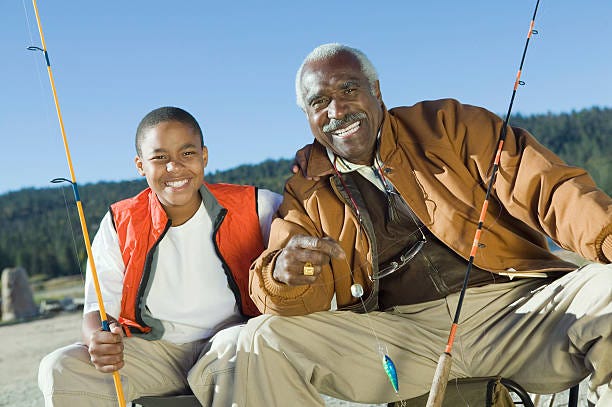
The red and white bobber danced on the surface of Lake Minnewaska, catching the early morning sun like a tiny lighthouse. Seven-year-old Shane gripped his fishing rod with both hands, his knuckles white with concentration, his eyes fixed on that bobber as if it held all the secrets of the universe.
“Easy now,” Grandpa Wesley said softly from his lawn chair beside the boy. “You’re gonna squeeze that rod right in half.”
Shane loosened his grip slightly but didn’t take his eyes off the water. “But what if I miss it, Grandpa? What if a fish bites and I’m not ready?”
Wesley chuckled, a warm sound that seemed to blend with the gentle lapping of water against the weathered dock. “Son, fishing isn’t about being ready every single second. It’s about being present. There’s a difference.” He reached over and adjusted Shane’s Twins cap, which had slipped down over one eye. “See how that bobber’s just sitting there, peaceful-like? When a fish takes your bait, you’ll know. It’ll dip down, maybe dance a little. The lake will tell you when it’s time.”
They sat in comfortable silence, the kind that only exists between people who truly understand each other. A loon called from across the water, its haunting cry echoing off the pine-covered shores. The morning air was cool and clean, carrying the scent of wild roses and fish.
“There!” Shane shouted as the bobber dipped beneath the surface.
“Wait for it,” Wesley cautioned, his hand hovering near Shane’s shoulder. “Wait... now!”
Shane yanked back on the rod, and the line went taut. His face lit up with pure joy as he felt the weight and pull of something alive on the other end. Wesley guided his small hands, helping him reel in a respectable sunfish that flashed gold and orange in the sunlight.
“I did it, Grandpa! I really did it!”
“You sure did, buddy. You sure did.”
By the time Shane was twelve, the bobber had been retired. He’d graduated to weighted sinkers and could cast a line forty feet out into the lake with practiced ease. Grandpa Wesley’s boat—a modest fourteen-footer with a fifteen-horsepower Evinrude that coughed to life like an old man clearing his throat—became their weekend sanctuary.
“Feel that?” Wesley asked one Saturday morning as they drifted near a weed bed. “The way the line goes slack, then tight? That’s a bass testing your bait. He’s curious but cautious.”
Shane nodded, his face serious with concentration. At twelve, he was all elbows and knees, growing into himself. But out here on the water, he moved with confidence, reading the lake the way his grandfather had taught him.
They caught five bass that morning, releasing four and keeping one for dinner. On the ride back, the little outboard motor puttering faithfully, Wesley watched his grandson’s profile against the Minnesota sky and felt a contentment so deep it almost hurt.
The high school years came like a storm, fast and chaotic. Shane still went fishing with his grandfather, but the trips became less frequent. There were football games, a driver’s license, a used Mustang that needed constant attention, and a girl named Jennifer with green eyes and a laugh that made Shane forget about everything else.
“Can’t make it this weekend, Grandpa,” Shane said over the phone one Friday evening. “Got a date with Jen, and then the guys want to work on my carburetor.”
“That’s alright, son,” Wesley replied, and he meant it. This was how life worked. Boys became men, and men had to find their own way. “You go have fun. The fish will still be here.”
But Wesley went out alone that Saturday, the boat feeling larger somehow with just one person in it. He caught three nice walleye and thought about the passage of time, about how the best moments in life were often the quiet ones you didn’t fully appreciate until they were gone.
Shane excelled at the University of Minnesota, then at law school. He was driven, focused, brilliant. He called his grandfather every Sunday evening without fail, their conversations a lifeline across the miles.
“Made partner, Grandpa,” Shane announced one Sunday, his voice crackling with pride and exhaustion. He was only thirty-two. “Youngest in the firm’s history.”
“I’m proud of you, son. Your grandmother would’ve been so proud.” Wesley’s voice was warm but tired. He was seventy-eight now, and the years were catching up. “When are you coming home?”
“Soon, Grandpa. I promise. This case is just... It’s consuming everything right now.”
“I understand. You go do what you need to do.”
The stroke came on a Tuesday morning in March. Wesley had been reaching for his coffee when his left side simply stopped working, his arm falling useless to his side, his leg buckling beneath him. The neighbor found him three hours later.
Shane got the call at his office in downtown Minneapolis. He was in his car within ten minutes, making the two-hour drive to Alexandria in ninety minutes, his heart hammering the entire way.
The hospital room was sterile and cold, filled with beeping machines and the antiseptic smell that seemed to define illness. Wesley looked small in the bed, diminished, his left side slack and unresponsive. But his eyes were alert, and when he saw Shane, they filled with tears.
“Hey, Grandpa,” Shane said, pulling a chair close and taking his grandfather’s good hand. “You scared me.”
Wesley tried to speak, but the words came out slurred and frustrated. Shane squeezed his hand. “It’s okay. Don’t push it. The doctors say you’re going to be fine. You’re tough. You’re going to beat this.”
The rehabilitation was brutal. Wesley worked with a determination that amazed his therapists, pushing through pain and frustration to regain his speech, his movement, his independence. But the medical bills were staggering. Even with Medicare, the deductibles and co-pays mounted like snowdrifts.
Shane visited when he could, which wasn’t often enough. On one visit in July, he found his grandfather sitting on the porch of his small house, staring out at the lake in the distance.
“Sold the boat,” Wesley said quietly. His speech had improved dramatically, though he still struggled with certain words. “Had to. The insurance deductible was eating me alive.”
Shane felt something crack inside his chest. “Grandpa, I could have—”
“No.” Wesley’s voice was firm. “You’ve got your own life, your own expenses. I’m fine. It’s just a boat.”
But it wasn’t just a boat, and they both knew it. It was Saturday mornings and patient lessons. It was the smell of two-stroke oil and the feel of sun-warmed aluminum. It was every memory they’d built together on the water.
“We’ll go fishing again,” Shane promised, his voice thick. “Once you’re fully recovered, we’ll go fishing again. I promise.”
Wesley nodded, but his eyes remained on the distant lake.
By October, Wesley had made a full recovery. His doctors called it remarkable. Wesley called it stubbornness. He walked without assistance, his speech was clear, and he’d even started doing his own yard work again.
Shane called on a Thursday evening. “I’m coming up this weekend. Saturday morning. We’re going fishing.”
“From the bank?” Wesley asked. “That’s fine. I’ve got my old tackle box somewhere.”
“Just be ready at dawn, Grandpa. Wear your fishing vest.”
Saturday morning arrived cool and clear, the kind of October day that makes Minnesota famous. The leaves were at peak color, the maples burning red and gold against an impossibly blue sky. Shane pulled up at five-thirty, just as the first light was touching the horizon.
Wesley was waiting on the porch, his old fishing vest on, a thermos of coffee in his hand. He looked good—strong and healthy, more like the grandfather Shane remembered from childhood.
“Ready?” Shane asked, grinning.
“Ready as I’ll ever be for bank fishing,” Wesley replied. “Though I’ll tell you, my knees aren’t what they used to be for standing on rocks all day.”
They drove to the public access on Lake Minnewaska, the same lake where Shane had caught his first fish all those years ago. Shane parked the truck and grabbed a tackle box from the back.
“Come on,” he said, leading his grandfather down the path toward the water.
But instead of heading to the bank, Shane turned toward the dock. And there, tied to the end of the weathered boards, was a boat. Not just any boat—a beautiful eighteen-foot Lund with a gleaming Mercury outboard, a fish finder, comfortable seats, and a trolling motor. The morning sun reflected off its metallic blue hull like light off water.
Wesley stopped walking. His mouth opened, then closed. He looked at Shane, then back at the boat, then at Shane again.
“Shane... what did you do?”
“I kept my promise, Grandpa. I said we’d go fishing again.”
“But this... this is too much. This must have cost—”
“It cost exactly what it should have,” Shane interrupted, his own eyes now wet. “You taught me patience. You taught me to read the water, to wait for the right moment. You taught me that the best things in life aren’t rushed.” He put his hand on his grandfather’s shoulder. “I’m sorry it took me so long to remember that. I’m sorry I let work and life get in the way of what really matters.”
Wesley’s face crumpled, tears streaming down his weathered cheeks. He pulled Shane into a fierce hug, the kind that says everything words cannot.
“Thank you,” he whispered. “Thank you, son.”
They stood there for a long moment, two men on a dock, connected by love and memory and the promise of mornings yet to come.
Finally, Wesley pulled back, wiping his eyes and laughing. “Well, are we going to stand here crying like a couple of fools, or are we going fishing?”
Shane laughed too, the sound carrying across the water. “Let’s go fishing, Grandpa.”
They loaded their gear into the boat, and Shane started the motor. It purred to life smoothly, a far cry from the old Evinrude’s cough. As they pulled away from the dock, the sun broke fully over the horizon, painting the lake in shades of gold and amber.
Wesley sat in the bow, his face turned toward the wind, a smile playing at his lips. Shane watched him from behind the wheel and felt a peace he hadn’t known in years. The lake spread out before them, vast and welcoming, full of possibility.
“Where to, Grandpa?” Shane called over the motor.
Wesley pointed toward a familiar weed bed on the far shore, the same spot where they’d caught bass all those years ago. “There,” he said. “Let’s start there.”
As they skimmed across the water, the boat cutting a clean wake through the morning stillness, Shane thought about bobbers and patience, about time lost and time regained. He thought about the man in the bow who had taught him not just how to fish, but how to be present, how to appreciate the quiet moments that make up a life.
The loon called again, its cry echoing across Lake Minnewaska, and Shane smiled. They were home.
© 2026 Smiling Through the Tears. All rights reserved.
I want to offer you our paid subscription for just $2.49 monthly or $24.99 per year. That’s 50% off our normal rate. I’m trying to grow this page, and that rate is good for life.
Thank you for considering it. I greatly appreciate your support!
Click HERE for 50% off!

WHY did you make me cry so hard? I’d just finished praying at sunrise and this made my open heart overflow. Thank you soo much!! Bless you!
I was just going to say the same thing. Dog gone you Jason. 🥲🥲🥲 This story should definitely pull at the heart strings of everyone who reads it. ❤️